Core functions for safe, reliable and efficient railway operations
Reducing detrimental effects through vibration isolation


Baseplate pads

Elastic insertion pads for sleeper boots

Mass-spring systems

Under ballast mats

Under sleeper pads
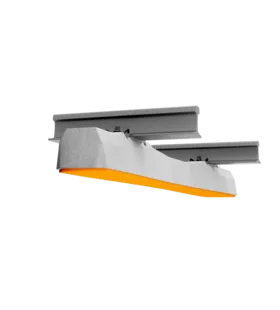
Sustainable protection for the superstructure


Under ballast mats
Under sleeper pads
Rail pads

Baseplate pads
Noise reduction


Services


Further information and questions
Vibration emissions due to railway traffic
Noise and vibration emissions are significant environmental impacts that occur in the context of railway traffic and can significantly impair the quality of life of residents. But what are the causes of so-called railway noise? Understanding the differences between vibrations and airborne noise is important when it comes to taking appropriate measures aimed at minimising these negative impacts.
Airborne noise is primarily caused by the sounds produced by the physical railway itself: the wheels rolling on the tracks and trains passing by. These sounds spread through the air in the form of sound waves and can be perceived as noise.
Vibrations, on the other hand, arise due to the mechanical oscillations that are generated when the wheels come into contact with the rails, and are transmitted through the ground. These vibrations can have an influence on buildings and structures, potentially resulting in perceptible movement and even damage.
The environmental impacts caused by these emissions pose a challenge that calls for both technological and design solutions. Equipping tracks with effective vibration isolation, such as an elastic bearing or special damping systems, can help to reduce the transmission of vibrations. Likewise, noise-absorbing materials and noise barriers can minimise airborne noise and thereby improve the quality of life in neighbouring residential areas.


Isolating vibrations at source
Elasticity in the railway superstructure
One effective means of vibration isolation is to use elastic bearings such as under sleeper pads in the ballast bed. This involves installing elastic materials under the sleepers to function as vibration dampers. Mass-spring systems are also a suitable alternative for use on slab tracks. These technologies are designed to reduce vibrations before they can be transmitted further through the track bed and subsoil. This also increases the service life of the components protected this way, while reducing maintenance costs.


Heavy strain in specific areas
Tracks are subjected to especially high loads in certain areas, such as tight curves or turnouts. The strain that occurs here isn't just evidenced by higher wear and maintenance costs; it is also a source of vibrations and noise in many cases.
Integrated solutions
The key is finding the ideal solution for the respective situation on the track. Getzner offers customised solutions for the entire railway network. We use our knowledge and decades of experience to find the right product for your individual requirements. In many cases, the objectives will go hand in hand: custom vibration isolation may be necessary for structural reasons as well as providing lasting protection for the superstructure and suppressing the transmission of noise and vibrations.


Passive measures to counteract noise and vibrations
Passive steps play a crucial role in minimising the impacts vibrations have on surrounding structures and buildings. These techniques address the affected properties and are designed to reduce the extent to which oscillations are transmitted and detected.
Resilient bedding of buildings
The use of elastically mounted floor panels and special foundations plays a significant part in preventing the transmission of vibrations. These structures are designed to absorb and dissipate oscillations before they reach the building, thereby significantly reducing the impact of vibrations on the building structure.
Diaphragm walls
Vertical diaphragm walls also help to reduce the transmission of vibrations from the surrounding environment. These measures can be applied either directly at the building or along the transmission path and can thus be deployed regardless of the foundation or as follow-up measures for existing buildings.


Structural improvements
Sound control windows are made of several layers of glass and special gaskets that significantly reduce noise levels. Installing these windows generally creates an effective barrier against noise immissions arising from outside, particularly if prescribed reference points, or trigger values, are exceeded. They are often included in noise abatement programmes and help to improve quality of life, particularly in residential areas along railway lines.
Active noise insulation for railway infrastructure
Active sound control works directly at the source of the noise and is therefore used on vehicles and transportation routes. The most common measure consists of setting up acoustic barriers made of aluminium, or constructing noise control walls or other means of shielding.
These barriers prevent the transmission of airborne noise to protect nearby residential areas and industrial estates from disturbances caused by noise. However, they can have a detrimental effect on the surrounding area due to their appearance, and in many cases do not prevent the transmission of vibrations and secondary airborne noise.


Technology and new materials in track construction
Elastic bearings
Elastic bearings under the ballast or sleepers function as dampers that absorb vibrations and thus reduce the transmission of oscillations. Our polyurethane-based materials are durable, maintenance-free and flexible, and thus have a successful record in track construction lasting many decades.


Track construction technologies
Modern track construction technologies utilise a wide range of methods to reduce vibrations, including specially designed rail profiles, optimised track geometry and elastic rail pads. These technologies help to efficiently absorb the oscillations that arise and prevent them from being transmitted to the subsoil.
Optimised track geometry
Modifying the track geometry can reduce noise levels and help trains run more quietly. Optimised curve radii and inclines contribute to reducing noise pollution and vibrations.
Use of noise-absorbing materials
Using noise-absorbing materials along railway lines for special noise barriers or sound-insulated track bedding reduces the transmission of airborne noise and has a positive impact by creating more pleasant noise levels.
Contact

